|
Q: General Internet What is your
connection to the Seton's of Winton in Scotland?
My
family line is from East Lothian in Scotland, descended from Sir John Seton
of Barnes, 3rd son of George, 7th Lord Seton by his wife
Isobel Hamilton of Sanquhar. Some of the
grandchildren of Sir John Seton had settled on the Moneylagan Estate, and once displaced from that estate,
had remained in Ireland, and, who are of heirs-male lineage of the Earl's of Dunfermline.
However, due to the
challenges of sourcing information in Irish records
there have been error's, between two different John Seton's:
one from the Barnes line and one from the Meldrum line
which caused significant confusion in tracing the family
information.
This has been corrected, and it should be noted by the
Nova Scotian Seeton/Seaton family that we are in fact descended
from the Seton's of Barnes line.
Because the old family Bible was
lost in a fire at the Seeton house on the Seeton farm in
Nova Scotia, much of the documented history of the family
line had been lost. However there were records from the
local Presbyterian parish of Glenholm, we did have the family
traditions that had been passed on through the
generations as keys to help re-construct our history:
We knew that we originated from at
the Seton Palace, at Seton in Scotland; that our
ancestor was a brother to Mary Seton who was the famed
hand-maid to Queen Mary, and that the Royal Family was of blood relation; that our family had been
instrumental in saving the life of Queen Mary and also
of King James VI and I; we knew that we had served in
the Royal Courts and helped raise King James' sons; that
our ancestor had served in a Royal Court in Europe; that
there was a Highland-connection and a connection to Fyvie Castle; that we were in line as heirs of a Title;
that our direct-ancestor was from
a John Seton's
line, who's descendant had settled in Ireland; that the
family had owned an estate in Ireland and had lost it;
that there was enmity between our family and that of the
Forbes' as a result of a feud over our land in Ireland.
Our
ancestor then, was Sir John
Seton, Lord Barnes and 1st Baron of Barnes who was a
diplomat and Knight of the Order of St. James in Spain (St. Jago) and of the Kings personal bodyguard,
a Gentleman of the BedChamber and Master of the Kings Household, under King
Philip II of Spain.
Recalled home to Scotland by King James VI and I
who, "not wanting so noble a subject to be excluded from
his court", was
made Master of the Kings Horse, Master of the Kings Household (1586)
like his illustrious father, Treasurer, and an
Extraordinary Lord in the College of Justice and sat in Parliament as Lord Barnes (1588) in place
of his brother Alexander Seton (at that time Lord Urquhart, later Lord Fyvie
and 1st Earl of Dunfermline) who was promoted to President of the College.
Sir John Seton was named as heir male of his younger
brother, following his own heirs male, which later made
the Seton's of Barnes the heirs of the Lordships of Fyvie
and Urquhart,
and the Earldom of Dunfermline. It was he
who had begun the Spanish-styled castle of Barnes in
East Lothian, which was never completed beyond the first
level following his death, which remains still exist
and are now commonly-known as the Barney Voults, or
Vaults.
Sir John
Seton, 2nd Baron of Barnes and heir of his father, was
educated in France and Spain, and became a Gentleman of the Privy
Chamber and officer of the Court of King Charles I.
He
was also a noted companion of the Marquis of Montrose, in
1646 for which he was fined heavily.
He acquired land in Ireland from Sir Robert
Gordon of Lochinvar, the estate of
Monylagan (Mionylangain or Moneylagan), Clongish Parish, in Co. Longford before 1646
and is occassionally referred to as Sir John Seaton of Mionylangain,
Longford.
Noted in the Funeral of Chancellor Seton in 1622, he acquired the lands of Hailes from the heir of Hercules Stewart of Whitelaw (d. 1594),
Francis Stewart.
The Moneylagan estate was active in
Linen production, which made the estate worth more the
500 pounds sterling a year.
Some of the Seton-Seaton-Seeton
descendants of Sir John Seton, 2nd Baron of Barnes and
of Moneylagan, settled and maintained the estate in
Ireland (such as Hannibal Seaton) before it passed out of the family in the
mid-1700's through the actions of the Viscount of
Granard, who was expanding his estate there.
Sir George Seton,
Knight, 3rd
of Barnes (and 2nd of Hailes or "Haillis"): was
a noted scholar at Oxford and was frequently referred as George Seatton of Hallis, or Dr. Seaton,
and
who had obtained a Degree of M.A.
granted by University of St. Andrews, Doctor of Theology, and was a fellow
of St. John's College, Cambridge circa 1619-1629, noted in the
"Memorabilia Cantabrigiae" where in he was recommended
personally by King James VI and I.
Sir John Seton 4th of
Barnes, and of 3rd of Hailes (d. 03.1659): active in the affairs of
his father, he succeeded but
died a relatively young man shortly afterwards in Edinburgh, and was
buried at his request, "with decency, but without pomp or great show",
and interred in the place of his father's burial at Seton Collegiate
Church. He was however twice married: his son George from his first
marriage succeeding him; and from his second marriage to
Lady Margaret Hay, the daughter of 9th Earl of Erroll
and sister to Lady Ann Hay who married George Seton, 3rd
Earl of Winton, he had son's:
John Seton who settled in Ireland and from whom descend
the Seaton/Seeton's of Nova Scotia; and Hannibal Seton
who also had settled for a time on the family estate in
Ireland, before returning to Scotland and becoming a
Burgess of Haddington; as well as other issue.
Sir George Seton, 5th of Barnes
Proclaimed the Pretender in 1715, and was acknowledged
as the heir of the Earldom of Dunfermine. He
likewise claimed the Lordship of Urquhart, including the
Abbott's House in Elgin, before selling the Lordship to
the Gordon's.
The Seton's of Barnes have had
descendants in both Scotland and Ireland, as well as into the America's, and the Senior
representative in the late 1700's and early 1800's was
Governor of St. Vincent and the Grenadines, heir to the
Earldom of Dunfermline.
The Seeton's in Ireland and Nova
Scotia then, descend from the younger son of Sir John
Seton, 4th of Barnes,
John Seton (or Seaton, younger of Barnes)
who married m.
Anna Lothian (married by the Dean, Mr. William Annand on 30th May, 1684) and
who settled
in Ireland. Their grandson, Thomas Seaton is the ancestor.
The Seton's of Barnes having
long held an interest and lands, in Ireland, and who
were likewise long-active Mason's. It is of no
surprise then that our family that had settled in Ireland and
continued the Masonic traditions there, brought them
to Nova Scotia.
Click to
read more
My 3rd great-grandfather, James Seton
(Seaton-Seeton),
was descended from Thomas Seaton and was born in the Scottish
plantation of Ulster in 1776. He married Martha Crawford
(of the Moneylagan-Crawfords) in Donaghmore, Co. Donegal
by the Rev'd Samuel Dill in
1808, and in 1822 left with his family from Belfast, Ireland and settled in Glenholm,
Londonderry, Nova Scotia, Canada.
The family in Nova Scotia were
highly respected, active in real estate acquisition and
were prominent Mason's. They were
also involved in various business ventures including: farming,
grocery and Robert and Joseph Seeton's shipping business
which held the contract for the overseas mail in the
mid-to-late 19th century, as well as The Old Public House in downtown Halifax, which
miraculously survived the Halifax Explosion during World War I.
Robert and Joseph were both younger
sons of James Seeton (I), and their older brother, also James
(2nd),
acquired lands in various parts of Nova Scotia, finally settling
in Meagher's Grant on what became known as the Seeton Farm. The family farm there was passed to his
son, also James (3rd), who had my grandfather Harold there in "The
Grant". Harold had, as his oldest son, Robert Seeton, my
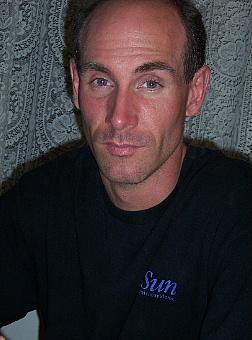
father, and I am Robert's oldest son. I now live in Montreal, Quebec,
Canada. I am then, 6th generation in descent from James Seeton
of Nova Scotia, where I was born in 1967.
Q: General Internet Do you have
any children?
I have three children, from my first marriage to
Lorelee Mae Remus, of Montreal, Quebec, Canada. We
were married while living in Ottawa, Canada (marriage in
Bethesda, Washington, D.C., Aug. 25 1990). My three children are Sarah
Elizabeth Seton b.1993), James Alexander Seton (b.1994)
and Natasha Mary Seton (b.1997). Lorelee sadly
passed away in Oct. 2000 and I subsequently married,
2nd, Maryna Syerhyeyeva of Kherson, Ukraine, in 2003
(later div, np).
Q: General Internet What can you
tell us about yourself? What
do you do for a living?
As a
descendant of the House of Seton, I have a passion for
preserving our family's history; which of course has resulted
in this website and for which I put countless years
into. My life's work is both a combination of
this, and of my career in telecommunications.
My
father was a soldier who later took up carpentry and my
mother was a senior training and policy officer at National Defense and
the Government of Canada and at the University of Ottawa, and they influenced me greatly.
I spent three years piping with the Regiment of the Cameron
Highlanders of Ottawa, and have travelled throughout the
world; with a passion for Asia, and China in particular.
I am a Telecommunications Professional, having spent all
of my career in that industry. I started
working in the Technology and Telecommunications field
when I was 18 years old, where my first exposure working
in technology was at a company called "Filtran", in
Ottawa, Canada, manufacturing electronic components.
Shortly afterwards I got a job working at Canadian
Marconi, assembling telecom circuit boards, and it was
that job that changed my life. There I was able to learn
the basics of fiber-optics, which skill later enabled me
to work doing fiber-optics installations, which I was
introduced to by a few friends who got me a job with
a company "Elan": contracted to build the data
communications infrastructure for Stentor Canada, where
I became a Field Supervisor after two years. I
went on to work at Belnet Canada in both Ottawa and in
Halifax, Nova Scotia, performing large commercial data
and voice communications installations, where I was a
senior technology consultant and was later promoted to
Vice-President of Operations for Eastern Canada 1996-97.
After 1 year of service there, I moved my young
family to Montreal in 1997, where I
began working as a consultant for various companies as well as
operating my own small communications business for two
years, and where my youngest daugher was born. In
1999, I took opportunity to join Frontier ConferTech as a 2nd level
Global Field Technician and worked to be the local Engineering Site Manager for the
Montreal facility, and I stayed on during the merger
with Global Crossing and was promoted to 3rd Level
Engineering, working with both the Conferencing Division
as well as with Transmission Engineering for the global
fiber optics design and support group.
Following the bankruptcy of Global Crossing, and
with almost 20 years in direct telecom design, installation,
support and
management, I was offered to join SITA, (the
Societe Internationale de la Telecommunications
Aeronautique) in their newly forming Global Network
Operations Centre, which they were undertaking to build
in Montreal, Canada, and as the first employee hired to
be part of the team there. Following a successful 5 years at SITA, I
left to pursue a position at Superclick Networks, in the Hotel
industry's wireless and HSIA service, managing
their installations around the world, and was very
successful in the Asian contracts. Presently, I for
the Norwegian communications pioneering company,
TANDBERG, with the Videoconferencing service and support
team in Montreal.
>
Next
page
|