|
 The
West Lothian lands of Winchburgh, or Wynchelburgh, were granted to
Philip de Setoun by King William in one of the original Charters
granted to the Seton family in 1169. It is one of the oldest
Scottish Charters to exist, now held by the Earl of Eglinton and
Winton. The castle was more commonly known as Niddry-Seton, to
distinguish it from Niddry Marischal near Edinburgh. The
West Lothian lands of Winchburgh, or Wynchelburgh, were granted to
Philip de Setoun by King William in one of the original Charters
granted to the Seton family in 1169. It is one of the oldest
Scottish Charters to exist, now held by the Earl of Eglinton and
Winton. The castle was more commonly known as Niddry-Seton, to
distinguish it from Niddry Marischal near Edinburgh.
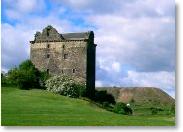
A tall massive tower of
late 15th/early 16th century construction and standing on a rocky
knoll, was long now ruinous and roofless. It is by design an
L-shaped tower on plan and was formerly surrounded by a barmkin or
curtain wall with corner towers, traces of which are to be seen on
the W. Additional defence was given by a bend in a stream, now
diverted because of the nearby railway.
An additional storey was added on top of the tower; however as it
now stands, it is 4 storeys high to the parapet, of which only the
corbelling remains, and for all of the 15th/16th century work, now
only fragments of the later additions remain above. The interior,
also long inaccessible, has likewise begun to be restored.
The construction
of the Castle as we know it was begun on the hereditary lands of Winchburgh in
the late 15th century by George, 5th Lord Seton, a great favourite
of his King. He was held in high esteem by James IV,
but he was not able to oversee the completion of the Castle, falling
with his sovereign on the fatal field of Flodden in 1513. He left a
widow, eldest daughter of the first Earl of Bothwell, who survived
him for a period of nearly half a century. It was to his wife and
son, the 6th Lord Seton, who oversaw the completion of
the Castle in the early 16th century, adding a further storey as
part of the major remodelling, and having more in-common with that
of Glamis.
During the "Rough Wooing" the castle
became the principle residence of the 6th Lord Seton, as the Palace of
Seton was under English occupation, and it was during this period
that the castle was enlarged and highly embellished, with the
elaborate 5th storey and it's ogee-roofed dormer windows added,
for which nothing now remains.
Niddry came to the forefront in history
in the latter-16th century when George, 7th Lord Seton came to the
rescue of Queen Mary Stuart. Lord Seton was Provost of both
Edinburgh and Elgin, and held the office of Grand Master of Queen
Mary’s household, and was concerned in not a few of the most
momentous events in her history. The night after the murder of
Rizzio, when Mary fled from Holyrood, her first halting-place was
Seton House, where Lord Seton was in readiness at the head of two
hundred horsemen to escort his sovereign to the strong castle of
Dunbar. A few days after the murder of Darnley, Mary repaired to
Seton House, where she was entertained by its owner in person, and
spent her time in hunting and shooting.
On the Queen’s escape from Douglas
imprisonment at Lochleven, Lord Seton was waiting in the vicinity of
the lake with fifty of his retainers and 200 lances, and attended
her in her rapid flight to his castle of Niddry, on his Winchburgh
estate in West Lothian, where she first drew bridle. Having crossed
the Forth at Queensferry, it is here at Niddry Castle that on the
2nd of May 1568, she gave instructions for the raising of her
adherents and then rapidly moved on to Cadzow Castle in Lanarkshire,
pausing at Craignethan Castle along the way.
He fought on her
side and was taken prisoner at the battle of Lang-side, in 1568,
which ruined her cause in Scotland. Sadly, on 13th May her
army was defeated at Langside by the better-led army of her
half-brother, the Earl of Moray. Fleeing southwards and staying at
the house of a friend each consecutive night, Mary arrived at
Dundrennan Abbey on 15th May, on the shores of the Solway Firth.
From there, she sailed to England, never to set foot in Scotland
again.
Later at Niddry, Lord Seton
celebrated the marriage of his daughter Margaret to Claud Hamilton
in 1574, the famed Politician
and Commendator of Paisley Abbey, the fourth son of James Hamilton
(1516-75), 2nd Earl of Arran and 1st Duke Châtelherault and younger
brother of the 3rd Earl of Arran. Hamilton was created the 1st
Baron Paisley in 1587, and their son became the 1st Earl of
Abercorn.
The
Castle was again twice besieged
unsuccessfully by the Regent Morton, and later the English Army
quartered in and around it on Septh 14th, 1650, during
Cromwell's revolution, and according to the chronicle, the 'Historie
of James the Sext', it was twice attacked; in April and June. In
April, the Captain with forewarning repelled a night attack. He
suspended heavy timber beams around the tower and released them
on a party climbing scaling ladders. The garrison of Edinburgh
Castle supported Niddry by attacking Merchiston Castle, which
was held for James VI of Scotland, as a diversion.
Niddry Castle is situated in a quiet
and open location, right opposite the more modern village of Winchburgh and
flanked by a golf course. The former castle village which was
situated beside, is infortunately long gone. The Reid Family,
Hereditary Keepers of Niddry Castle, and it's grounds gardeners,
left after the castle was sold to the Hope's and later settled in
Ulster, Northern Ireland.
Achealogical-work in 1989 concentrated on the W barmkin wall and
interior, and over thirty post-holes of varying shape, size and
alignment were found in this part of the site alone. Some of these
underlay or lay outside the W barmkin wall. The remains of a
rectangular stone building 14m by 6.8m aligned NS lay just W of the
tower-house. This had another wall making the corner of a yard 7.5m
wide EW, abutted to its SW corner. The NW part of the barmkin wall
overlay that corner of the earlier buildings while while two drains
and a garderobe-chute were in the west part of the wall. These
served a building 5.5m wide within its walls which stood against the
W barmkin wall. This only survived at the S end, due to the slope in
the bedrock. At some time after the demolition of the barmkin wall a
heavy flagged floor was laid over the S end for a timber building.
Among other finds during this year were two more iron spurs,
possible furniture or woodwork fittings and lead window-glass
mountings. The pottery was mostly sherds of reduced green-glazed
fabric with some post-medieval imported ware and possible
earlier vessels of oxidised fabric. The final season of
excavation was of trenches across the edges of the excavated
area. A small patch of burnt stone was found against the outside
of the N end of the barmkin wall, associated with pipe fragments
of 17th century type. The cobbled yard, with the S barmkin wall,
against which it is built, were found to overlie and cut into a
pebble floor and flagged path. The latter was aligned
approximately SE-NW.
On
the E, a low slope opposite the E barmkin wall was found to be a
dump of pale sandstone and turf, made into a level platform 10m
wide. This was on the natural glacial till, into which was cut a
post-hole, with a post-pipe 0.16m wide, and 8.6m E of the
barmkin wall. The trench through the midden on the N slope
allowed a section to be drawn of the deposits, from the
tower-house to the filled-in course of the Niddry Burn. From the
deposits abutting the burn came two sherds of the rim of a
cooking-pot of reduced ware.
The
plaster in the E window of the third floor of the tower-house
was removed during the restoration work, revealing a small stone
aumbry in the S side. Removal of the blocking revealed a stone
shelf and a hemispherical hollow in its base. The broken stump
of a stone table with a chambered edge was visible in the E
wall, corresponding with scars of removal of its mortared stone
base in the E side and the E part of the N and S sides. These
seem to have been the remains of an altar and of a piscina, for
what seems to have been an oratory or the castle chapel.
In
passing from the Seton's, around 1680, the castle and Estate were
forced to be sold as part of security and fine for the release of
George Seton, Master of Seton and Lord Seton, heir of George Seton,
3rd Earl of Winton, and passed to the Hope family and became part of
the Hopetoun estate. The Hope family, now Marquesses of Linlithgow,
long held the subsidiary title Baron Niddry. In the 1990s, Niddry
was restored as a private residence, and formerly a Scheduled
Monument, the tower was de-scheduled in 1996 to allow restoration.
It is now privately-owned and not open to
the public, although one can get a good view by walking all around the
building via the surrounding golf course.
|